Courts Use of Review Standards in Roe V Wade
On January 22, 1973, the Supreme Court handed down a decision that continues to divide the nation to this day. In Roe v. Wade, the Court ruled that a state police that banned abortions except to save the life of the mother was unconstitutional under the Fourteenth Amendment. The determination has proven to be one of the nigh controversial cases in the Court's history.
Norma L. McCorvey discovered that she was pregnant in June 1969. It was to exist her 3rd child, but McCorvey wished to accept an abortion. At the time, Texas law merely immune for abortion in cases of rape, incest, or to save the life of the female parent. McCorvey was brash by her friends to falsely affirm that she had been raped, but in that location was no police report to back up this claim. Instead, McCorvey attempted to have an illegal abortion, only she soon discovered that the regime had shut down the facility.
McCorvey visited a local attorney seeking advice on what to do side by side. The chaser assisted McCorvey with beginning the process of putting her kid up for adoption, and also referred her to Linda Coffee and Sarah Weddington, two recent graduates of the Academy of Texas Law School.
Coffee and Weddington brought a lawsuit on McCorvey'due south behalf (who went by the allonym "Jane Roe" throughout the case to protect her identity) claiming that the state'south police violated Roe'south constitutional rights. The adapt claimed that, while her life was not in danger, Roe had a right to obtain an abortion in a safe, medical environment within her home country. The Usa District Court for the Northern District of Texas agreed, and ruled that the Texas police force violated Roe's correct to privacy plant in the Ninth Amendment, and was therefore unconstitutional.
Texas appealed the decision to the Supreme Court, and the case reached the Courtroom in 1970. However, the Court decided to wait to hear Roe until they had decided Younger five. Harris and Us v. Vuitch. Afterward the Court appear the decision in Vuitch, which upheld the constitutionality of a Washington, D.C. statute that similarly outlawed abortion, the Court voted to hear Roe and the closely related case of Doe 5. Bolton.
Arguments in the case began on December 13, 1971. Shortly earlier that date, Justices Hugo Black and John Marshall Harlan II retired from the bench. Main Justice Warren Burger decided that Roe and Doe, also as the other cases that were scheduled on the docket, should go along as planned.
Jay Floyd, who was representing Texas in the instance, opened his argument with what commentators accept described as the "worst joke in legal history." In reference to Coffee and Weddington, the female attorneys representing McCorvey, Floyd began by proverb, "Mr. Main Justice, and may it please the Court. It's an old joke, but when a man argues against two beautiful ladies like this, they are going to take the final word."
The balance of the case was argued that day. However, equally Justice Harry Blackmun was attempting to draft a preliminary opinion based upon the law'due south vagueness in May 1971, he proposed to his colleagues that the case be reargued. Afterward some debate on the issue, the case was reargued on October xi, 1972. Texas Banana Attorney General Robert C. Flowers replaced Jay Floyd for the example's reargument in front of the Court.
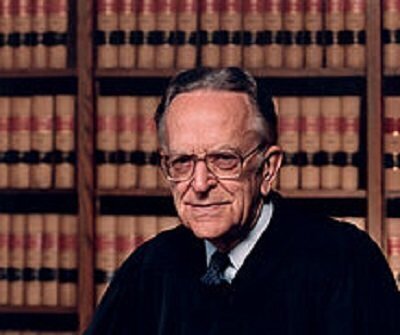
Justice Blackmun remained equally the justice selected to the Courtroom's stance following the 2nd statement, and on January 22, 1973, the Court issued its 7-2 determination. In it, the Court determined that Texas had violated Roe'due south ramble right to privacy.
Drawing on the First, Fourth, Ninth, and Fourteenth Amendments, the Court said that the Constitution protects an private's "zones of privacy." Citing before cases that ruled that contraception, marriage, and kid rearing were activities included in these "zones of privacy," the Court found that the zone was "wide enough to comprehend a adult female's decision whether or not to end her pregnancy."
Because the Court determined that abortions were within a woman'southward "zone of privacy," it was therefore ruling that a woman had a cardinal right to the procedure. Although this right was fundamental, that did not mean that it could non exist express.
The Court said that every bit a fundamental right, any limitations on abortion must run across the standards of strict scrutiny. This meant that there must have been "compelling state interest" in regulating abortions, and the legislation must have been narrowly tailored to meet this "compelling" land interest.
The Court and so assessed the state's interests. Justice Blackmun found two legitimate government interests: protecting the mother'south health and "protecting the potentiality of human life." In guild to balance the fundamental privacy right to abortion with these 2 land interests, the Court created the trimester framework. This solution determined when the correct to abortion would be without limitations, and when the state'south interests would be compelling enough to outweigh the woman's right to choose.
The Court said that, during the first trimester, the abortion decision was left to the woman and her dr.. Following the outset trimester, until fetal viability, the country'south interest in the mother's health reaches the compelling level, and the state can regulate the procedure, simply if it "reasonably relates to the preservation and protection of maternal health." When the point of fetal viability is reached, then the state could protect its involvement in "potential life" and regulate ballgame to that end. This includes banning that practice of abortion at that stage in the pregnancy.
In 1992, the Court adjusted the trimester framework in Planned Parenthood of Southeastern Pennsylvania v. Casey. In that instance, the plurality asserted, under the Fourteenth Amendment, that the mother had a ramble right to ballgame and that this correct could not be disproportionately interfered with by the state prior to viability—what'southward known now as the "undue burden" test.
Ever since the Roe five. Wade decision was issued in 1973, the case has remained one of the most contentious in the public sphere. It has inspired political campaigns and motion, and sparked debates throughout the nation effectually ethics, religion, biology, and constitutional police force.
Source: https://constitutioncenter.org/interactive-constitution/blog/landmark-cases-roe-v-wade
0 Response to "Courts Use of Review Standards in Roe V Wade"
إرسال تعليق