Josãƒâ© Clemente Orozco David Alfaro Siqueirosand David Rivera Art Work
| David Alfaro Siqueiros | |
|---|---|
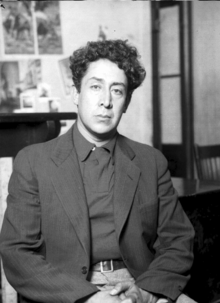 Portrait of Siqueiros, year unknown | |
| Born | (1896-12-29)December 29, 1896 Chihuahua, Mexico |
| Died | January vi, 1974(1974-01-06) (anile 77) Cuernavaca, Morelos, Mexico |
| Nationality | Mexican |
| Education | San Carlos University |
| Known for | Painting, Muralist |
| Notable work | Portrait of the Bourgeoisie (1939–1940), The March of Humanity (1957–1971) |
| Movement | Mexican Mural Move, Social Realism |
| Awards | Lenin Peace Prize 1966 |
David Alfaro Siqueiros (built-in José de Jesús Alfaro Siqueiros; December 29, 1896 – Jan 6, 1974) was a Mexican social realist painter, all-time known for his big public murals using the latest in equipment, materials and technique. Along with Diego Rivera and José Clemente Orozco, he was one of the most famous of the "Mexican muralists".[1] He was a fellow member of the Mexican Communist Party, and a Stalinist and supporter of the Soviet Spousal relationship who led an unsuccessful attempt to electrocute Leon Trotsky in May 1940.[ii]
By accordance with Castilian naming customs, his surname would normally accept been Alfaro; yet, like Picasso (Pablo Ruiz y Picasso) and Lorca (Federico García Lorca), Siqueiros used his mother'southward surname. It was long believed that he was born in Camargo in Chihuahua state, but in 2003 it was proven that he had actually been born in the city of Chihuahua, but grew up in Irapuato, Guanajuato, at least from the age of six. The discovery of his birth certificate in 2003 past a Mexican art curator was announced the post-obit twelvemonth by art critic Raquel Tibol, who was renowned equally the leading authorization on Mexican Muralism[three] and who had been a close acquaintance of Siqueiros.[4] Siqueiros inverse his given proper name to "David" afterward his first wife called him by information technology in innuendo to Michelangelo'south David.[4] [5]
Early life [edit]
Many details of Siqueiros's childhood, including birth date, birthplace, first name, and where he grew up, were misstated during his life and long afterwards his death, in some cases past himself. Often he is reported to have been born and raised in 1898 in a town in the state of Chihuahua, and his personal names are reported to be "José David". Thanks to fine art historian Raquel Tibol, who establish a birth certificate for him, nosotros know now that he was born in Mexico City, not Camargo or the state of Chihuahua.
Siqueiros was built-in in Chihuahua in 1896, the second of three children. He was baptized José de Jesús Alfaro Siqueiros.[4] [5] His begetter, Cipriano Alfaro, originally from Irapuato, was well-off. His mother was Teresa Siqueiros. Siqueiros had two siblings: a sister, Luz, three years elder, and a blood brother "Chucho" (Jesús), a year younger. David's female parent died when he was four and their begetter sent the children to alive with their paternal grandparents.[6] David's grandfather, nicknamed "Siete Filos" ('seven knife-edges'), had an specially strong part in his upbringing. In 1902, Siqueiros started school in Irapuato, Guanajuato.
He credits his beginning rebellious influence to his sister, who had resisted their father'southward religious orthodoxy. Around this time, Siqueiros was also exposed to new political ideas, mainly along the lines of anarcho-syndicalism. One such political theorist was Dr. Atl, who published a manifesto in 1906 calling for Mexican artists to develop a national art and look to ancient indigenous cultures for inspiration.[vii] In 1911, at the age of fifteen, Siqueiros was involved in a pupil strike at the University of San Carlos of the National Academy of Fine Arts that protested the school's educational activity methodology and urged the impeachment of the school's manager. Their protests eventually led to the establishment of an "open-air academy" in Santa Anita.[7]

At the age of eighteen, Siqueiros and several of his colleagues from the School of Fine Arts joined Venustiano Carranza's Constitutional Regular army fighting the government of President Victoriano Huerta.[ commendation needed ] When Huerta fell in 1914, Siqueiros became enmeshed in the "post-revolutionary" infighting, as the Constitutional Regular army battled the diverse political factions of Pancho Villa and Emiliano Zapata for control.[seven] His military travels around the country exposed him to Mexican culture and the raw, everyday struggles of the working and rural poor classes. After Carranza's forces had gained control, Siqueiros briefly returned to Mexico City to paint before traveling to Europe in 1919. Commencement in Paris, he captivated the influence of cubism, intrigued particularly with Paul Cézanne and the use of big blocks of intense color. While in that location, he also met Diego Rivera, another Mexican painter of "the Big Three" on the brink of a legendary career in muralism, and he traveled to Italia to study the great fresco painters of the Renaissance.[vii] In Barcelona he published a magazine, La vida Americana, in which he issued a manifesto to the artists of America to reject the decadent influence of Europe and create a new course of public art with the latest tools and technology.
Early art and politics [edit]
Although many have said that Siqueiros' artistic ventures were frequently "interrupted" by political ones, Siqueiros himself believed the two were intricately intertwined.[8] By 1921, when he wrote his manifesto in Vida Americana, Siqueiros had already been exposed to Marxism and seen the life of the working and rural poor while traveling with the Constitutional Regular army. In "A New Management for the New Generation of American Painters and Sculptors", he called for a "spiritual renewal" to simultaneously bring back the virtues of classical painting while infusing this style with "new values" that acknowledged the "modern auto" and the "contemporary aspects of daily life".[9] The manifesto too claimed that a "constructive spirit" is essential to meaningful art, which rises above mere decoration or imitation, fantastical themes. Through this style, Siqueiros hoped to create a way that would bridge national and universal art. In his work, as well as his writing, Siqueiros sought a social realism that hailed the proletariat peoples of United mexican states and the world, even every bit it attempted to avoid the widespread clichés of "Primitivism" and "Indianism".[x]

Mural past David Alfaro Siqueiros in Tecpan, c. 1944
In 1922, Siqueiros returned to United mexican states City to work as a muralist for Álvaro Obregón'southward revolutionary regime. The then Secretarial assistant of Public Education, José Vasconcelos, fabricated a mission of educating the masses through public art, and hired scores of artists and writers to build a modern Mexican culture. Siqueiros, Rivera and Orozco worked together under Vasconcelos, who supported the muralist motility by commissioning murals for prominent buildings in Mexico City. Still, the artists working at the Preparatoria realized that many of their early works lacked the "public" nature envisioned in their ideology. In 1923 Siqueiros helped found the Syndicate of Revolutionary Mexican Painters, Sculptors and Engravers, which addressed the problem of public access to art through its newspaper, El Machete. That year Siqueiros helped author a manifesto in the paper "for the proletariat of the world". It addressed the necessity of "commonage" art, which would serve as "ideological propaganda" to brainwash the masses and overcome bourgeois, individualist art.

Siqueiros painting a mural circa 1925
Soon after, Siqueiros painted his famous mural Burying of a Worker (1923) in the stairwell of the Colegio Chico. The fresco features a group of pre-Conquest style workers in a funeral procession that are conveying a giant coffin, busy with a hammer and sickle.[11] The mural was never finished and was vandalized past students at the school who did not concord with the work's overtly political subject thing. Eventually, the entire mural was whitewashed by the new Minister of Education who succeeded Vasconcelos.[12] The Syndicate became ever more than critical of the revolutionary regime, due to the State'due south failure to deliver on promised reforms. As a result, its members faced new threats to cut funding for their fine art and the paper. A feud inside the Syndicate—regarding a pick between publishing El Machete or losing financial back up for mural projects—led to Siqueiros moving to the forefront of the organization, when Rivera left in protest over the decision to prioritize politics over art. Despite being dismissed from a post at the Department of Instruction in 1925, Siqueiros remained securely involved in labor activities, in the Syndicate as well equally the Mexican Communist Party, until he was jailed and eventually exiled in the early 1930s.[seven]
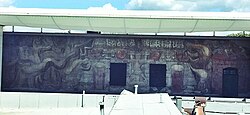
After spending many years in Mexico and being heavily involved in radical political activities, Siqueiros went to Los Angeles, California in 1932 to continue his career equally a muralist. Working in a collective unit that experimented with new painting techniques using modern devices such as airbrushes, sprayguns and projectors,[thirteen] Siqueiros and his team of collaborators painted two major murals. The first, entitled Street Coming together, was commissioned for the Chouinard School of Art. Information technology depicts a grouping of workers of mixed ethnicities listening to an aroused labor agitator's spoken language during a intermission in the workday.[xiv] The mural was done over inside a twelvemonth of its unveiling – due to weather-related bug, and perhaps the Communist content of the work. Siqueiros' other significant Los Angeles mural, Tropical America (full name: América Tropical: Oprimida y Destrozada por los Imperialismos, or Tropical America: Oppressed and Destroyed by Imperialism),[xv] was commissioned soon after the unveiling of Street Coming together, and was to be painted on the exterior wall of the Plaza Art Center that faced the decorated Olvera Street. Tropical America depicts American imperialism in Latin America, a much more than radical theme than was intended for the work. Although information technology received by and large favorable criticism, some viewed it equally Communist propaganda, which led to a fractional covering in 1934 and a full whitewash in 1938.[16] 80 years later, the Getty Conservation Institute performed restoration work on the mural.[17] As no color photographs of Tropical America are known to be, conservators used scientific analysis and best practices to get at the artist's vision of the landscape. It became attainable to the public on its 80th anniversary, Oct ix, 2012.[18] The América Tropical Interpretive Center that opened nearby is dedicated to the life and legacy of David Alfaro Siqueiros.[nineteen] [20]
Creative career [edit]

La Marcha de la Humanidad

Siqueiros (3rd from right) along with others during a tribute to Julio Antonio Mella circa 1930
In the early 1930s, including his time spent in Lecumberri Prison, Siqueiros produced a series of politically themed lithographs, many of which were exhibited in the United States. His lithograph Caput was shown at the 1930 exhibition "Mexican Artists and Artists of the Mexican Schoolhouse" at The Delphic Studios in New York City.[21] In 1932, he led an exhibition and conference entitled "Rectifications on Mexican Muralism" at the gallery of the Castilian Casino in Taxco, Guerrero.[7] Shortly after, he traveled to New York, where he participated in the Weyhe Gallery's "Mexican Graphic Art" exhibition. Also in 1932, Nelbert Chouinard invited Siqueiros to Los Angeles to conduct landscape workshops.[22] It was at this time that, with a team of students, he also completed Tropical America in 1932, at the Italian Hall at Olvera Street in Los Angeles.[23] Painting fresco on an outside wall – visible to passersby likewise equally intentional viewers – forced Siqueiros to reconsider his methodology as a muralist. He wanted the image – an Indian peon beingness crucified by American oppression – to be accessible from multiple angles. Instead of just amalgam "an enlarged easel painting", he realized that the mural "must conform to the normal transit of a spectator."[x] Eventually, Siqueiros would develop a landscape technique that involved tracing figures onto a wall with an electrical projector, photographing early wall sketches to amend perspective, and new paints, spray guns, and other tools to arrange the surface of modern buildings and the outdoor atmospheric condition. He was unceremoniously deported from the Us for political activity the same year.[24]

La nueva democracia ("The New Republic"), 1945, Siqueiros
Dorsum in New York in 1936, he was the guest of honor at the "Contemporary Arts" exhibition at the St. Regis gallery. There he also ran a political art workshop in preparation for the 1936 General Strike for Peace and May Day parade. The immature Jackson Pollock attended the workshop and helped build floats for the parade. In fact, Siquieros has been credited with instruction drip and pour techniques to Pollock that later resulted in his all-over paintings, made from 1947 to 1950, and which constitute Pollock's greatest achievement. In add-on to floats, the Siqueiros Experimental Workshop produced a diversity of posters and other imperceptible works for the CPUSA and other anti-fascist organizations in New York. These ephemeral works possessed the ability to attain the masses in a mode different from mural painting because they were attainable to a wide audience exterior of an establishment or gallery. The Siqueiros Experimental Workshop just lasted for a little over a year until Siqueiros went to fight in the Spanish Ceremonious War in April 1937, merely their floats were featured in both the 1936 and 1937 May Day Parades in Manhattan'south garment district.[25]
Standing to produce several works throughout the late 1930s – such as Echo of a Scream (1937) and The Sob (1939), both at present at the Museum of Modern Art in New York . Although he went to Spain to support the Castilian Republic confronting the fascist forces of Franciso Franco with his art, he volunteered and served in frontline combat as a Lieutenant Colonel in the Army of the Democracy through 1938 earlier returning to United mexican states City. After his render, in a stairwell of the Sindicato Mexicano de Electricistas, Siqueiros collaborated with Spanish refugee Josep Renau and the International Team of Plastic Artists to develop one of his most famous works, Portrait of the Bourgeoisie, warning against the dual foes of capitalism and fascism.[26] The original landscape, painted in the stairwell of the electrical worker's union, incorporated cameras, photomontage, spray guns, airbrushes, stencils and the latest paints. It shows a giant generator using the opposition of fascist and backer democracies to generate imperialism and war. An armed, brave-faced revolutionary, of unnamable grade or ethnicity, confronts the machine, and a blue heaven on the ceiling flanked by electrical towers displays hope for the proletariat in technological and industrial advances.
American-born poet and eventual fellow Castilian Ceremonious War participant Edwin Rolfe was a keen admirer of Siqueiros's "ability to function" as "artist and revolutionary".[27] His 1934 poem "Room with Revolutionists" is based on a conversation between ″New Masses″ editor, poet, and Left journalist Joseph Freeman (1897–1965) and Siqueiros;[27] in information technology, Siqueiros is described equally "a revolutionist / a painter of cracking areas, editor / of fiery and terrifying words, leader / of the poor who found, the poor who couch / nether the globe in field and mine. / His life's an always upward-delving boxing in / an sometime torn sweater, the pockets always empty."[28]
Attempted bump-off of Leon Trotsky [edit]
Earlier the mural's completion in 1940, however, Siqueiros was forced into hiding and later exiled for his direct involvement in an attempt to assassinate Leon Trotsky, so in exile in Mexico City from the Soviet Union:[7]
President Lazaro Cardenas had given Leon Trotsky and his wife, Natalia Sedova, political asylum afterward fleeing Stalinist persecution. They were able to enter the land thanks to the request that Ana Brenner made to Diego Rivera and Frida Kahlo to intervene on their behalf. Trotsky's inflow in Mexico every bit a political asylee infuriated the Spanish Republicans, allies of the Soviet Union, who complained to the Mexican fighters -among them Siqueiros- about their government's determination to have Trotsky.[29]
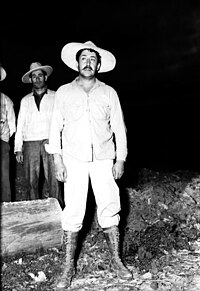
Siqueiros disguised every bit a farmer under the name of Macario Huízar in the Hostotipaquillo sierra, Oct 1940
In the early morning of May 24, 1940, Siqueiros led an attack on Trotsky's house in Mexico Urban center's Coyoacán suburb. (Trotsky, granted asylum by President Cárdenas, was then living in United mexican states.) The attacking party was composed of men who had served under Siqueiros in the Castilian Ceremonious War and of miners from his union. After thoroughly raking the firm with motorcar gun burn down and explosives, the attackers withdrew in the belief that nobody could accept survived the assault. They were mistaken. Trotsky was hale and lived till August, when he was killed with an ice pick wielded by an assassin[thirty]
Trotsky'south xiii-year-former grandson was shot, all the same survived.[31] Following the attack, police found a shallow grave[32] on the road to the Desierto de los Leones with the trunk of New York Communist Robert Sheldon Harte, executed[33] by 1 shot to the caput. He had been i of Trotsky'due south bodyguards. The theory that Sheldon was a Soviet amanuensis who had infiltrated Trotsky's entourage, aiding in Siqueiros' attack past allowing the hit squad to enter Trotsky's chemical compound, was discounted by Trotsky and afterwards historians.[34] Siqueiros'southward colleague Josep Renau completed the SME mural, transforming the generator into a machine that converts the claret of workers into coins.
Siqueiros was located by the police in a property supposedly rented by Angelica and Luis Arenal -Siqueiros' wife and brother-in-law respectively- in the outskirts of the capital. Siqueiros fled to Guadalajara, hiding in the house of his old friend and from there he moved to the mountain town of Hostotipaquillo. Together with Angélia Arenal, he hid disguised as a peasant under the name of Macario Huízar. The Jalisco police force apprehended Siqueiros and took him to Mexico Metropolis, where he was formally processed and declared prisoner in the Lecumberri Preventive Prison, accused of having committed attempted homicide, criminal clan, improper apply of uniform, usurpation of functions, breaking and entering, firing a firearm and robbery.[29]
Despite Siqueiros'southward participation in these events, he never stood trial and was given permission to leave the state to paint a mural in Chile, arranged by the Chilean poet Pablo Neruda. In a schoolhouse library in the town of Chillán, he organized a squad of artists to paint a mural which combined the heroic figures of Mexico and Chile in "Death to the Invader."
Hoping to revisit the United states of america and contribute to the struggle against fascism, he was denied entry and went to Cuba where he painted three murals, "Apologue of Racial Equality and Fraternity in Cuba," "New Day of the Democracies" and "Two Mountains of America, Marti and Lincoln."
Later life and works [edit]

Unfinished 1940s mural painted past David Alfaro Siqueiros, in Escuela de Bellas Artes, a cultural heart in San Miguel de Allende, Gto.
In 1948, Siqueiros was invited to teach a class on mural painting at an art academy in San Miguel Allende. Although he was barred from the The states, most of the students were American GIs who were existence paid to study under him. Practicing his idea of learning art by working with a master artist on a mural project, he planned a landscape in a colonial edifice recognizing the legacy of Miguel Allende, one of United mexican states's leaders of the struggle for independence. The landscape was never completed, due to legal procedures against the owner of the art academy. Based on this experience, he subsequently wrote a volume Como se pinta un mural.

Siqueiros participated in the commencement ever Mexican contingent at the XXV Venice Biennale exhibition with Orozco, Rivera and Tamayo in 1950, and he received the 2d prize for all exhibitors, which recognized the international status of Mexican art.[35] [36] Yet by the 1950s, Siqueiros returned to accepting commissions from what he considered a "progressive" Mexican state, rather than painting for galleries or private patrons.[36] He constructed an outdoor mural entitled The People to the University, the University to the People at the National Autonomous University of Mexico in United mexican states City in 1952. It was a combination of mural painting, bas-relief sculpture and Italian mosaic. In 1957 he began work on 4,500-square-human foot (420 m2) government commission for Chapultepec Castle in United mexican states Metropolis; Del porfirismo a la Revolución was his biggest landscape all the same.[36] (The painting is known in English as From the Dictatorship of Porfirio Diaz to the Revolution or The Revolution Against the Porfirian Dictatorship.)

In the lobby of the Hospital de la Raza in United mexican states City, he created a revolutionary multi-angular mural using new materials and techniques, For the Social Welfare of all Mexicans. Subsequently painting Man the Master and Non the Slave of Applied science on a concave aluminum panel in the lobby of the Polytechnic Institute, he painted The Amends for the Time to come Victory of Science over Cancer on panels that wrap around the lobby of the cancer center.[35]
Yet near the terminate of the decade, his outspoken communist views alienated him from the government. Under pressure from the government, the National Actors' Association, which had commissioned a mural on the theater in Mexico suspended his piece of work on The History of Theater in United mexican states at the Jorge Negrete Theater and sued him for breach of contract in 1958.[37]

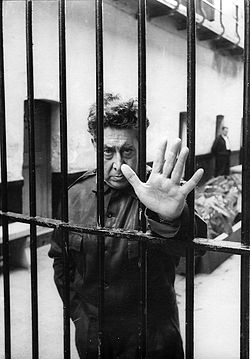
Siqueiros was somewhen arrested in 1960 for openly criticizing the President of Mexico, Adolfo López Mateos, and leading protests against the arrests of hitting workers and teachers, though the charges were usually known to be simulated.[35] Numerous protests ensued, even including an appeal advertisement by well-known artists and writers in The New York Times in 1961.[38] Unjustly imprisoned, Siqueiros continued to pigment, and his works continued to sell.[36] During that stay, he would make numerous sketches for the project of decorating the Hotel Casino de la Selva, endemic by Manuel Suarez y Suarez. After international pressure was put on the Mexican government, Siqueiros was finally pardoned and released in the spring of 1964. He immediately resumed working on his suspended murals in the Actors' Spousal relationship and Chapultepec Castle.
When the mural planned for the Hotel de la Selva in Cuernavaca was moved to United mexican states City and expanded, he assembled a team of national and international artists to work on the panels in his workshop in Cuernavaca.[35] This projection, his last major mural, is the largest mural always painted, an integrated structure combining architecture, in which the building was designed as a landscape, with landscape painting and polychromed sculpture. Known as the Polyforum Siqueiros, the exterior consists of 12 panels of sculpture and painting while the walls and ceiling of the interior are covered with The March of Humanity on Globe and Toward the Creation.[35] Completed in 1971 after years of extension and delay, the mural broke from some previous stylistic mandates, if only past its complex bulletin. Known for making fine art that was hands read by the public, specially the lower classes, Siqueiros' message in The March is more difficult to decipher, though information technology seems to fuse 2 visions of human progress, one international and one based in Mexican heritage.[36] The mural'south placement at a ritzy hotel and commission past its millionaire owner besides seems to challenge Siqueiros' anti-capitalist ideology.[36]
Siqueiros died in Cuernavaca, Morelos, on January 6, 1974 in the company of Angélica Arenal Bastar, who had been his partner since the Spanish civil war. His torso was buried in the Rotunda of Illustrious Persons in United mexican states City.[39] A few days before his decease, he donated his house in Polanco to the Mexican country; since 1969, it had been used for Public Fine art Rooms and a Museum of Mural Painting Composition.
Style [edit]


As a muralist and an artist, Siqueiros believed art should be public, educational, and ideological. He painted mostly murals and other portraits of the revolution – its goals, its by, and the electric current oppression of the working classes. Because he was painting a story of human struggle to overcome authoritarian, capitalist rule, he painted the everyday people ideally involved in this struggle. Though his pieces sometimes include landscapes or figures of Mexican history and mythology, these elements often appear as mere accessories to the story of a revolutionary hero or heroes (several works depict the revolutionary "masses", such as the mural at Chapultepec).[forty]
His involvement in the human form adult at the Academy in Mexico Metropolis. His accentuation of the angles of the body, its muscles and joints, tin can exist seen throughout his career in his portrayal of the strong revolutionary trunk. In addition, many works, peculiarly in the 1930s, prominently characteristic easily, which could be interpreted as another heroic symbol of proletarian strength through piece of work: his self-portrait in prison (El Coronelazo, 1945, Museum of Modern Art, United mexican states Metropolis), Our Nowadays Paradigm (1947, Museum of Mod Art, Mexico), New Democracy (1944, Palace of Fine Arts, Mexico Urban center), and even his series on working grade women, such every bit The Sob.
Gallery [edit]
-

Peasants (c. 1913)
-
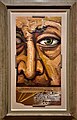
"Yo por Yo" self-portrait, David Alfaro Siqueiros, dedicated to Fernando Gamboa museographer and promoter of the Mexican art, Baronial 1956.
Major exhibitions [edit]
- Siqueiros, at Casino Español, United mexican states City, 1932.[41]
- lxx Recent Works from David Alfaro Siqueiros, at the Museo Nacional de Artes Plásticas, Mexico City, 1947.[41]
- Siqueiros, at Galeria de Arte Mexicano, Mexico City, 1953.[41]
- Siqueiros: Retrospective Exhibition 1911–1967, at the Museo Universitario de Ciencas y Arte, Mexico Metropolis, 1967.[41]
- Siqueiros-Exposición Retrospectiva, at the Tokyo National Museum, Tokyo, 1972.[41]
- Siqueiros: Exposción de Homenaje, at the Instituto Nacional de Bellas Artes, United mexican states City, 1975.[41]
- Siqueiros-Visión, Tecnica y Estructural, at the Instituto Nacional de Bellas Artes, Mexico City, 1984.[41]
- Images of United mexican states, at the Dallas Museum of Art, Dallas, 1988.[41]
- Latin American Artists of the Twentieth Century, at the Museum of Modern Art, New York, 1993.[41]
- Vida Americana: Mexican Muralists Remake American Art 1925–1945, at the Whitney Museum of American Art, New York, 2020.[42]
See also [edit]
- Mexican muralism
- Mexican art
- La Tallera
- List of people from Morelos, Mexico
Selected other works [edit]
- Proletarian Mother, 1929, Museum of Mod Fine art, Mexico
- Zapata (lithograph), 1930, Tehran Museum of Contemporary Fine art
- Zapata (oil painting), 1931, Hirshhorn Museum and Sculpture Garden, Smithsonian, Washington, D.C.
- América Tropical, 1932, Los Angeles[20]
- War, 1939, Philadelphia Museum of Fine art
- José Clemente Orozco, 1947, Carillo Gil Museum, Mexico City
- Cain in the United States, 1947, Carillo Gil Museum, Mexico city
- For Complete Social Security of All Mexicans, 1953–36, Hospital de La Raza, Mexico City
Further reading [edit]
- Debroise, Olivier. Otras rutas hacia Siqueiros. Mexico Urban center: INBA/Curare, 1996.
- Debroise, Olivier. Then Far from Heaven: David Alfaro Siqueiros' "The March of Humanity" and Mexican Revolutionary Politics. Cambridge: Cambridge University Press, 1987.
- González Cruz Manjarrez, Maricela. La polémica Siqueiros-Rivera: Planteamientos estéticos-políticos 1934–35. United mexican states Metropolis: Museo Dolores Olmedo Patriño, 1996.
- Harten, Jürgen. Siqueiros/Pollock: Pollock/Siequeiros. Düsseldorf: Kunsthalle, 1995.
- Jolly, Jennifer. "Art of the Collective: David Alfaro Siqueiros, Josep Renau, and their Collaboration at the Mexican Electricians' Syndicate." Oxford Art Periodical 31 no. one (2008) 129–51.
- Portrait of a Decade: David Alfaro Siqueiros. Mexico City: MUNAL/INBA, 1997.
- Siqueiros, David Alfaro. "Rivera's Counter-Revolutionary Route." New Masses, May 29, 1934.
- Siqueiros: El lugar de la utopía. Exhibition catalogue, Mexico City: INBA and Sala de Arte Pública Siqueiros, 1994.
- Tamayo, Jaime. "Siqueiros y los orígenes del movimiento rojo en Jalisco: El movimiento minero." Estudios sociales 1, no. i (July–October 1984): 29–41.
- Tibol, Raquel. Siqueiros, vida y obra. Mexico Metropolis: Colección, 1973.
- Tibol, Raquel, David Alfaro Siqueiros, Shifra M. Goldman, and Agustín Arteaga. Los murales de Siqueiros. Mexico City: Instituto Nacional de Bellas Artes, 1998.
Notes [edit]
- ^ "Siqueiros Paintings, Bio, Ideas". The Art Story . Retrieved 2019-ten-18 .
- ^ The art story, life and legacy
- ^ Conaculta 2011.
- ^ a b c Proceso 2004.
- ^ a b Gente Sur 2005.
- ^ Stein 1994, pp. 14–16.
- ^ a b c d eastward f g Stein 1994.
- ^ "David Alfaro Siqueiros / Collective Suicide / 1936". MoMA. Retrieved 11 November 2014.
- ^ Calles 1975, p. 21.
- ^ a b Calles 1975.
- ^ Laurance P. Hurlburt, The Mexican Muralists in the U.s. (Albuquerque, North.M.: University of New Mexico Press, 1989), 203.
- ^ Brenner, Anita (1929). Idols Behind Altars. New York: Payson & Clark Ltd. pp. 244–59.
- ^ D. Anthony White (2009). Siqueiros: Biography of a Revolutionary Artist. Booksurge. p. 145. ISBN978-i-4392-1172-iv.
- ^ Hurlburt, Laurance (1989). The Mexican Muralists in the United States . Albuquerque, NM: University of New Mexico Press. pp. 210–xiii. ISBN0826311342.
- ^ Del Barco, Mandalit. Revolutionary Mural To Return To Fifty.A. Subsequently 80 Years. npr. October 26, 2010. Retrieved June 18, 2015.
- ^ Hurlburt, Laurance (1989). The Mexican Muralists in the United States . Albuquerque, NM: University of New United mexican states Printing. pp. 213. ISBN0826311342.
- ^ "Conservation of América Tropical" The Getty Conservation Constitute website Accessed 14 Nov 2014
- ^ Whalen, Timothy P. (Oct 9, 2012) "América Tropical Is Reborn on 80th Birthday" The Getty Iris The J. Paul Getty Trust
- ^ América Tropical Interpretive Eye Official website
- ^ a b "'America Tropical': A forgotten Siqueiros mural resurfaces in Los Angeles". Los Angeles Times. September 22, 2010. Archived from the original on 2011-02-06.
- ^ Ruth Green Harris, "Art That Is Now Being Shown In the Galleries," The New York Times, December seven, 1930.
- ^ Karlstrom, Paul J. (1996). On the border of America: California Modernist Fine art 1900–1950. Berkeley, Los Angeles, Oxford: University of California Press. p. 130.
- ^ Lucie-Smith 2004, p. 63.
- ^ Langa, Helena. Radical Fine art: Printmaking and the Left in 1930s New York. Berkeley, California: University of California Printing, 2004. ISBN 978-0-520-23155-ix. p. 234.
- ^ Hurlburt, Laurance (1976). "The Siqueiros Experimental Workshop: New York, 1936". Art Journal. 35 (3): 237–46. doi:10.1080/00043249.1976.10793284. JSTOR 775942.
- ^ Jolly, Jennifer (2009). "The Art of the Commonage". Oxford Fine art Journal. 31 (1): 129–51. doi:x.1093/oxartj/kcn006.
- ^ a b Rolfe, Edwin, Cary Nelson, and Jefferson Hendricks. Copse Became Torches: Selected Poems. Urbana: University of Illinois Press, 1995. p. 146
- ^ Rolfe, Edwin, Cary Nelson, and Jefferson Hendricks. Trees Became Torches: Selected Poems. Urbana: Academy of Illinois Press, 1995. p. 85
- ^ a b Cabrera Nuñez, Eduardo César; Valentina de Santiago Lázaro, María (2007). Siqueiros. Cronología biográfica. Ayuntamiento de Guanajuato.
- ^ "The creative person as activist: David Alfaro Siqueiros (1896–1974)". Mexconnect.com. Retrieved eleven November 2014.
- ^ Mike Lanchin (28 August 2012). "Trotsky'southward grandson recalls ice pick killing". BBC News . Retrieved 15 January 2019.
Volkov was hitting in the pes
- ^ Ted Crawford; David Walters, eds. (May 1942). "The Murder of Robert Sheldon Harte". 4th International. three (5): 139–42. Retrieved xv January 2019.
a calendar month later on, on June 25th, Bob's lime-covered body was found in a shallow grave
- ^ "Index and Concordance to Alexander Vassiliev's Notebooks and Soviet Cables Deciphered by the National Security Agency'south Venona Project" (PDF). Wilson Center. Woodrow Wilson International Heart for Scholars. 1 November 2014. pp. 175–76. Retrieved fifteen January 2019.
Harte left alive with the raiders merely was found expressionless a few days later.
- ^ Robert Service. Trotsky: A Biography. Belknap Press. 2009. p. 485-488
- ^ a b c d e Siqueiros, Biography of a Revolutionary Artist, (Book Surge, 2009)
- ^ a b c d due east f Leonard Folgarait, And so Far From Heaven: David Alfaro Siqueiros' The March of Humanity and Mexican Revolutionary Politics (New York: Cambridge University Press, 1987), 36.
- ^ Bruce Campbell, Mexican Murals in Times of Crisis (Tucson, Ariz.: The Academy of Arizona Press, 2003), 54.
- ^ "Siqueiros" (advertisement), The New York Times, August 9, 1961.
- ^ "Archived copy". rotonda.segob.gob.mx. Archived from the original on 3 December 2011. Retrieved 11 January 2022.
{{cite web}}: CS1 maint: archived copy equally title (link) - ^ Carolyn Hill, ed., Mexican Masters: Rivera, Orozco, and Siqueiros (Oklahoma Urban center: Oklahoma City Museum of Fine art, 2005), eighty.
- ^ a b c d e f m h i Stein 1994, pp. 380–81.
- ^ "Vida Americana: Mexican Muralists Remake American Fine art, 1925–1945". whitney.org . Retrieved 2020-03-14 .
References [edit]
- David Alfaro Siqueiros, art and revolution. Translated by Calles, Sylvia. London: Lawrence & Wishart. 1975.
- "David Alfaro Siqueiros, un artista cuya obra ha trascendido el tiempo y las fronteras". Conaculta (Regime of Mexico, Consejo Nacional para la Cultura y las Artes) Press release no. 26 (in Castilian). 2011-01-06.
- "El verdadero Origen de Siqueiros; lo que hay de cierto tras el mito del Coronelazo" [Siqueiros'due south true origin: the reality behind the myth of the Big Colonel]. Gente Sur (in Castilian). 2005-10-15. Archived from the original on 2014-04-07.
- Lucie-Smith, Edward (2004). Latin American Art of the 20th Century (second ed.). New York: Thames & Hudson.
- "Buscan fondos para la restauración del Polyforum" [Funds sought for the restoration of the Polyforum]. Proceso (in Spanish). 2010-12-28.
- Stein, Philip (1994). Siqueiros: His Life and Works. New York: International Publishers. ISBN0-7178-0709-six.
External links [edit]
- Siqueiros at the Museum of Mod Art, New York City
- Lne.es
- The Polyforum, United mexican states Metropolis
- Siqueiros on Artcyclopedia.com
- Siqueiros Image Banking concern (collection of photographs used by Siquieros for his work)
- Finding Aid for the David Alfaro Siqueiros papers at the Getty Research Institute
- 10 Dreams Galleries
- United mexican states Info Contour (in Castilian)
- Figureworks.com/20th Century work at www.figureworks.com
Source: https://en.wikipedia.org/wiki/David_Alfaro_Siqueiros
0 Response to "Josãƒâ© Clemente Orozco David Alfaro Siqueirosand David Rivera Art Work"
إرسال تعليق